Payment methods

Recycled skateboards are broken or worn-out decks that get a new use instead of going to landfill. Because a deck is made from layers of hard maple glued together, the wood is still strong and good-looking long after the board is too damaged to ride. Skaters, artists and small workshops turn that wood into jewelry, art, furniture and accessories. Around 2 million skateboard decks are thrown away every year, so there is no shortage of material.
We know this subject from the inside. Skate4create started in Vilnius, Lithuania, in 2014 with one idea: broken boards deserve better than the bin. Since then we have collected and reworked more than 10,000 decks. This guide explains what a skateboard is made of, why old decks are hard to recycle the usual way, what you can do with yours, and how we turn them into the pieces we sell.
Most skateboard decks are made of seven thin sheets of maple veneer, called plies, glued together and pressed in a mould that gives the board its concave shape and its raised nose and tail. That is why you will often see “7-ply” on a deck.
The standard skateboard deck wood is hard rock maple from the cold northern forests of Canada and the northern United States. It grows slowly, which makes it dense, stiff and springy at the same time. A Canadian maple skateboard can take thousands of landings on concrete and still give a good “pop” when the skater snaps the tail.
Deck makers often dye some of the plies before pressing. Those colours are invisible on a finished board because the bottom carries a printed graphic and the top is covered in grip tape. Cut a deck open and the stripes appear. That is what gives recycled skateboard wood its look, and every board is different.
The plies are held together with strong glue, the bottom is printed and lacquered, and the top has a sheet of sandpaper-like grip tape stuck to it. Those extra materials are part of why skateboard recycling is harder than it sounds.
A skater who rides hard can snap or wear out a deck within weeks or a few months. The wood itself is still fine, but a board with a crack, a chipped nose or a lost pop is no longer safe or fun to ride.
Ordinary recycling systems are not built for it. A deck is not clean timber: the glue, lacquer, printed graphic and grip tape mean it cannot simply be chipped and reused like untreated wood, and most waste collectors treat it as general rubbish. So the usual end for a broken board is a bin, a landfill site or an incinerator. Each one took a tree, a factory and shipping to make, and it was used for a few months.
That is the gap recycled skateboards fill. Reusing the wood keeps it in use for years and means no new tree is cut for the product made from it.
The two words are often used for the same thing, but there is a useful difference.
The board is broken down into raw material and rebuilt into something new. In our case, decks are cut into pieces and pressed together into new blocks of layered maple, which are then shaped into beads, pendants and keychains.
An upcycled skateboard keeps more of its original form. A whole deck becomes a shelf, a wall hanging, a swing seat or a piece of art, with little processing.
Both keep wood out of landfill. Recycling takes more work but lets you make small, precise objects from boards that are too broken for anything else.
If you have a pile of dead decks in a garage or a skatepark storage room, here are the most common options, from easiest to most creative.
Trucks, wheels and bearings usually outlive the deck. Keep them for your next setup, or give them to a beginner who is building their first board. A deck that is only scuffed, not broken, can go to a local skate programme or a friend who is learning. Youth skate projects and community skateparks are often short of gear, and a complete board with working trucks and wheels is worth far more to them than to a shed. Before you pass a board on, check it for cracks near the trucks, where decks often fail, so you don’t hand over something unsafe.
Some skate shops collect snapped boards and pass them to workshops that reuse the wood. We collect through partner skate shops, skateparks and skate communities. If you are in or near Vilnius and have broken decks to donate, get in touch with our workshop and we will work something out.
A deck with a graphic you love can be mounted on the wall with two brackets. Many skaters keep their first board or a deck from a favourite brand this way.
Old decks make good shelves, benches, stools and coat racks. The concave shape works well for seats. Sand the surface well, remove any loose splinters and seal the wood if it will be used daily.
Artists around the world cut old decks into mosaics, sculptures and wall pieces. The Japanese artist Haroshi, for example, is known for large sculptures built entirely from stacked, carved broken decks. On a smaller scale, cutting a few boards into strips and gluing them into a pattern is a good weekend project.
If you take on a recycled skateboard project at home, a few precautions save trouble. Remove the grip tape first: warming it with a hair dryer softens the glue so the sheet peels off in one piece. Take out every bolt and check for broken hardware stuck in the holes before you cut. Sanding through lacquer and glue makes fine dust, so wear a dust mask and work in a ventilated space or outdoors. And keep the offcuts, because even small pieces are enough for coasters, magnets or a keyring.
People searching for an eco-friendly skateboard often mix up two different things.
This is what we do: the material is a board that already existed and was ridden. Nothing new is grown or manufactured for the wood itself. The result is jewelry, art or furniture, not a new board to ride.
Some brands build new rideable boards from recycled plastic. Bureo, for example, makes small cruiser skateboards from recycled fishing nets collected in South America. Others use bamboo, which grows back quickly, or mix recycled fibres into the plies. These are good choices if you need a new board and want a lower footprint.
Both approaches matter. One reduces waste at the end of a board’s life, the other reduces the need for new raw material at the start. If you skate, the most sustainable board is still the one you already have, ridden until it breaks, and then passed on to someone who can reuse the wood.
Every piece in our shop starts as a broken deck. Here is what happens to it in our Vilnius workshop.
We gather broken and donated decks from skate shops, skateparks and the skate community. Boards that would otherwise go to landfill arrive at the studio.

Each deck is inspected and sorted. We remove the grip tape and the lacquer and prepare the wood for processing. We try to save every part of the board, because almost all of it can be used.

The boards are cut into smaller pieces, which shows their real colour layers. Pieces from several boards are glued and pressed together into a new block of recycled skateboard wood.
The block is shaped into beads, pendants or keychains and sanded by hand through several grits until each piece is smooth.
A protective varnish seals the wood, brings out the colour layers and gives the gloss. The finish is water resistant and durable.
Every finished piece is checked on its own before packing. If it does not meet our standard, it does not ship.
You can read more about each step on our about the workshop page.
Our range is deliberately small, and every item is made from real decks. We don’t paint or dye the boards, so the colours are whatever the original skateboard had inside.
Our recycled skateboard bracelets use beads from 6 mm to 10 mm, on waxed cord with adjustable knots or on stretch cord. The blue bracelet and the bold rainbow stretch bracelet show the layers especially clearly.

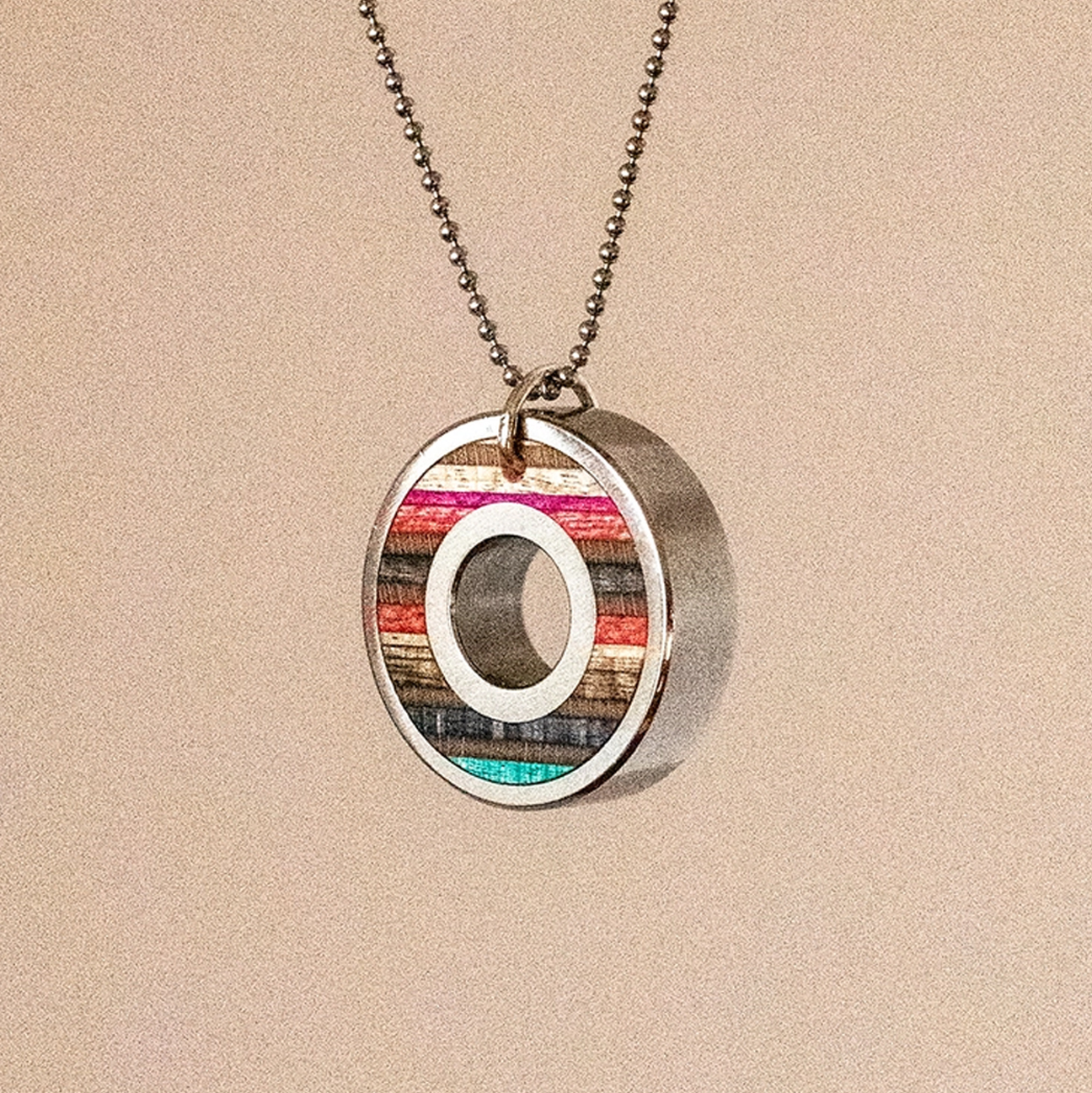
The bearing pendant necklace fits recycled board wood inside a stainless steel skateboard bearing. It joins two parts of a skateboard in one small piece.
The surfboard keychain is cut from a single deck and keeps the original printed graphic on its top side, so you can still see a bit of the board it came from.

All of them are part of our recycled skateboard jewelry collection, together with the other accessories made from old decks.
Many of the boards we work with come from skate shops. A shop that collects broken decks can also sell the finished pieces at its counter, which closes the loop in a way customers understand straight away: boards broken in the local park come back as bracelets in the same shop. If you run a skate shop, a gift store or a brand, our wholesale and custom orders page explains how stocking the range or ordering a custom run works.
As recycled skateboards became popular, so did lookalikes: new wood dyed in stripes, or plastic printed to look like layered maple. A few checks help.
Real deck wood shows thin, even plies with slightly irregular colours. Printed or painted stripes look too perfect and often wear off at the edges.
If every product in the photos looks identical, the material is probably not from real boards. Genuine recycled pieces always differ a little from one another.
A real maker can tell you where the boards come from and show the workshop. If the answer is vague, be careful.
Maple sealed with varnish is tough, but it is still wood. Keep it away from long soaks in water, swimming pools, the sea and the shower, and avoid contact with sunscreen, alcohol-based sanitisers and cleaning sprays, which can dull the finish. Wipe it with a dry soft cloth now and then. Our care guide for skateboard wood products has the full list.

Recycled skateboards are a small, practical answer to a real waste problem. A deck that would have been thrown away after a few months of riding can be worn every day for years. If you skate, think twice before binning your next broken board. If you are looking for a gift with a story, our pieces are made from boards that were really ridden.
For gift ideas built around these pieces, read gifts for skaters and surfers. To understand why reuse matters for everything you wear, see why sustainable fashion is important. And if you run a company or a shop, we also make custom gifts from recycled skateboards to order.
Broken or worn-out skateboard decks whose maple wood is reused instead of thrown away. The wood is turned into jewelry, art, furniture and accessories.
Usually not. The glue, lacquer, printed graphic and grip tape mean most collection systems treat a deck as general waste. Pass it to a skate shop or workshop that reuses deck wood instead.
Keep the trucks, wheels and bearings, then give the deck to a recycler, hang it on the wall, or turn it into a shelf, a bench or a piece of art.
Recycled means the deck is cut up and rebuilt into new material, as we do for beads and pendants. Upcycled means the deck keeps most of its shape, for example as a shelf or wall piece.
Yes. Skateboard decks are made of 7-ply Canadian hard rock maple built to take impacts. Sealed with a protective varnish, the wood is water resistant and lasts for years with basic care.